Monday, January 31, 2022

James McCarrell, weaver from Ireland: conversations with cousins


1/17/22 Dwight talked to Margaret McCarrell---

A professor from University of Tennessee came to the house and found holes in the door that James McCarrell used for the loom. Margaret has also seen a diary that James kept which included the bills he had for yarn that he bought to use in the loom. "In his own hand", he states in that diary that he was born in Ireland. Being of Scottish descent, many mistakenly have him listed as being born in Scotland.

From Cousin Dwight, the grandson of Margaret Viola Graham-Blake..

 1/16/2022

I think the loom was integrated onto the fireplace mantle and walls, with a series of hooks. That is, if I remember correctly.

Actually, this was the time period when England was taking over India, and also the first beginings of mechanization that would lead to the Industrial Revolution. They were making weaving more efficient, and also had cheaper labor in India. This lead to a gradual and long decline in the weaving industry of Northern Ireland. Jobs became harder and harder to find, as the same out put required less workers. So, the McCarrells and McKibbens, and presumable the Caswell Grahams, migrated to find new economic opportunties.

James McCarrell was also a minister. But, he found his calling in choir and singing. He lead the church in singing and music.

I think most genealogist would never have caught that it was James McCarrell Sr. (b. 1728) who was the father of all those young children. However, it was all recorded in the Bible [which Margaret McCarrell had at one time]. The only record that survived to prove this all.

There are alot of legends that I need to write down… There was another. He got the deed to his land in Knoxville in about 1800. He had to ride a horse all the way to Nashville to get it, as that was the only place where the deeds were issued. He then rode back by horse, and the very next day he took that original deed to the Knox County Court house and made sure that it was entered there also. There is a record of this special effort that he took. He must have been 75 years old when he made those journeys by himself… 


For more on the McCarrell Bible, click here


All these photos of the McCarroll/McKibbon Homestead: Somewhere when I put these all on Ancestry.com I told that they are all courtesy of Marcy Carter Lovick......

Wednesday, January 19, 2022

James McCarrell, Irish child immigrant


James McCarrell (my 5 great grandfather) was born in 1728, but travelled with his parents as a baby between 1728 and 1730 (when his sister was born in Pennsylvania) from Ireland to the British Colony of Pennsylvania as did many Protestant Irish at this time.

On Ancestry, people have him born in Scotland, others Ireland and still others in Letterkenny, Pennsylvania.  I am going to try to sort it out.

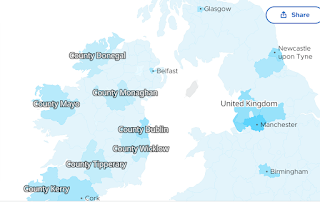
First, my DNA: If you look at  the map from 23andme, I am clearly more Irish than Scottish although my ancestors and I are Protestant. (Glasgow is the only Scottish blip)  What that really means is people TODAY who share my DNA live in those areas.  So, that doesn't really prove that they were Irish 500 years ago. Those from Scotland might have gone to Ireland with some staying behind and some moving on to America colonies.  Those would be the Scotch-Irish (which is one of my major ethnicities in DNA and on paper) or Scots-Irish.

And which Irish shading are the McCarrells?  Probably County Donegal in the northwest of Ireland where there is a town called Letterkenny (like in Pennsylvania).  I think some on Ancestry, for James birth place, might have hit save for the Pennsylvania town instead of the one in Ireland.  Another possibility is that the Irish from Letterkenny  who founded the Pennsylvania town in 1736 might have been friends or kin with the McCarrells urging them to settle there, too in1738.

So, I have Irish DNA, do I have any other proof James was born in Ireland?  Margaret McCarrell in Knox Co. TN  just told cousin Dwight in a telephone conversation January 2022 that she has seen James McCarrell's diary.  Margaret saw in that diary that James had written in his own hand that he was born in Ireland.  So, James McCarrell was born in Ireland, but was he Scotch-Irish?

Some have thought since the McCarrells were Protestant Irish, they must have been from Scotland originally, but I am leaning toward, they were Irish before the Scots settled there.  Several sites that discuss surname origins say it is an Irish name (I checked and the same sites said Graham was Scottish or Irish and Watson could be English, Scottish and Irish).  Those are clearly Scotch-Irish names, but that's not what is said about McCarrell

Recorded as MacCarroll, McCarroll, McCarrell, McCarle, Carroll, and others, this surname is Irish.
 
It is a developed form of the ancient name Mac Cearbhaill meaning 'The son of the warrior' from the personal name Cearbhall, a byname for a fierce warrior deriving from "cearbh", meaning to hack. There were two distinct clans, one in Leinster and the other in Ulster, where the name is often recorded as MacCarvill. The surname dates back to the early 14th Century (see below), and early examples of recordings include Donslevy Mac Carroll in 1357, described by the Four Masters as "a noble master of music and melody, the best of his time".  The first recorded spelling of the family name is shown to be that of Mulrory Mac Carroll, which was dated 1328. He was the Chief Minster of Ireland and Scotland, during the reign of King Edward 111rd of England, 1327 - 1377. 

© Copyright: Name Origin Research www.surnamedb.com 1980 - 2012

I am suggesting they may not have been Scottish at all.  The name dates to the 1300's long before the Scots were re-settled in Ireland.  When the Catholic Irish migration occurred more than 100 years later, all Protestant Irish from the colonial period were labeled "Scotch-Irish" because most were that.  But, I don't think the McCarrells were.  I think they were just rebellious Irish who were Dissenters or Non-comformists.  Those with this label were Methodists, Presbyterians, Quakers, but also could have been Baptists.  From their beginnings in the American Colony, the McCarrells appear to have been Baptist.  Was it because there were no Presbyterian churches for them to attend or was it because they had been Baptist in Ireland?

Saturday, January 15, 2022

Emigration of Ancestors--post Colonial

 My interest in genealogy stems from 2 questions:  What were Grandma Wicker's roots? Why did my ancestors emigrate?  Previous blogs identify many of Vennie's roots but I recently started thinking about my 2nd question.

When I began, I had no idea how far back my roots went in American history.  I knew that my g-g grandparents in Dad's family had immigrated from Germany and England but I didn't really know why.

Louis Reiter

According to my dad's cousins, Louis Reiter came from Germany to avoid being drafted in another German (Prussian) war.  The irony was he arrived just in time for America's Civil War in which he fought for the Union side.  This coincides with another Reiter family (DNA connected) who had a narrative about their family.  click here to read.  So, Louis reportedly came for political reasons probably around 1854 when we found a Ludwig Reiter on a passenger list into New York.  He was a blacksmith and possibly tried to settle in Pennsylvania where family lived.  We know he was in Missouri by 1862 when he enlisted in the Union army.

Eliza Tyrey

His wife was Eliza Tyrey whose mother was a Kilpatrick from Tennessee with Colonial roots.  But, her father, Jacob Tyrey, was from Prussia: Schwemlingen, Rheinland-Pfalz, Germany.  We don't know why he left but do know he was living in Wisconsin in 1836 according to the census there.  He was later identified as a miner so possibly he left for economic reasons.  But, he also probably left for political reasons since this area became Prussian in 1816 and Jacob (born in 1810) would have been subject to the draft also.

Louis Reiter and Eliza Tyrey's daughter was my great grandmother Mary Celecy Reiter McKee who married Thomas Long with Colonial roots. My other great grandparents were Henry Maupin (also Colonial roots) and Annie Reed whose parents were recent immigrants from England.

Seated:  Frances Glanville Reed and Annie Reed Maupin

Annie's mother's family John Glanville and Frances Hancock came from Camborne in Cornwall England sometime after 1841 but before my g-g grandmother (Francis Glanville) was born in 1843.  Having watched the series Poldark on PBS, I have a very good idea why they left: the mines were closing. The mines in Cornwall had been producing for thousands of years (click here) and it was becoming more and more difficult to mine, so they came to Valle Mines, MO where there was plenty of lead that was needed for bullets if nothing else.

William Farncombe/Reed

Annie's father, William Farncombe/Reed, was also from England:  Pyecombe near Brighton.  William Reed (aka Farncombe) is so far the only immigrant I have who left because he was in trouble (click here)  We don't know why he left England other than one of his sister's descendants saying he "left under a cloud".  Personally, I suspect bigamy or getting a young lady "in trouble".  He was married in 1850 to a woman in Kent (at 15 years old?)---this information was written on the back of his marriage certificate in French Village, Missouri to Frances Glanville. He was still living with his parents in 1851 according to the census in England, but was in the United States by 1860 living in Valle Mines, Missouri.

So they emigrated for economics, politics, a possible prison record which probably accounts for most emigration, however I have at least one from the Colonial era who came for religious reasons.

Sunday, June 13, 2021

Joseph Sollis


My family tree was a mess.  I had brothers and sisters marrying and having children.  While that's not unheard of especially among Egyptian monarchs, that didn't happen much in 19th century America.  So, I contacted several genealogist cousins to help me out.

Rae and Jason suspected the pair in question (Sena Sollis and Adam Sollis) were cousins:  Sena was the daughter of Martha Taylor and Luke Sollis; Adam was possibly the son of Joseph Sollis and Elizabeth Allen.  . . . .Joseph Sollis? The one that was hanged for murder?. .. . .I guess that's better than incest. . .. .

It had been so long since I'd heard about Joseph that I needed a refresher thanks to Jason and the internet.  The Sollis family lived in Duplin, North Carolina as did the Kornegay family.  They were definitely neighbors and might have inter-married.  We don't know much about the Sollis family during the colonial period but the Kornegays are well documented being plantation owners.  There are several indications that they were not only wealthy but  also used their influence in court cases involving intoxication  with assault and battery.

I haven't found the cause of the disagreement between Abraham Kornegay and Joseph Sollis but the end result was Joseph killed Abraham Kornegay.  There was a reward for Joseph's live capture:


Aug,2,  1826  North Carolina Journal August 2, 1826
-- JOSEPH SOLLIS, for whose apprehension a reward of $300 was offered, as the
murderer of ABRAHAM KORNEGAY of Duplin County, was arrested in Cumberland
County on Friday last, and committed to the jail in Fayetteville for safe-keeping. Since the death of KORNEGAY, SOLLIS has been lurking about his former residence in Duplin, until lately, he made the attempt to get off, with his wife and child, to the Western Country, but in this attempt was discovered and taken. SOLLIS had called at a house near the road to get water, and was recognized by the occupant, who gave information to an officer, and the neighbors, by whom he was taken.

He was captured and put on trial. Although I haven't found documentation, Jason said Kornegay's brothers were on the jury that sentenced Joseph Sollis to death by hanging.  

Wed. May 9, 1827   North Carolina Journal April 27, 1827

   EXECUTION -- JOSEPH SOLLIS, who was convicted at the last term of the

Superior Court for Duplin Court, of the murder of ABRAHAM KORNEGAY, underwent

the sentence of the law on Friday,m the 27th ultimo.

The newspaper article describing his execution is also interesting.

But the story doesn't end with Joseph Sollis's hanging.  Two of the Kornegay brothers tried to re- collect the reward for finding Joseph Sollis when it is clear in the earlier article that the occupant of a house turned him in.

This information is contributed by Carolyn Shank
Petition for Reward for Murder of Abram KORNEGAY-1828
Duplin County
The Committee of Claims to whom was referred a Resolution instructing them to enquire into the expediency of allowing Bryan KORNEGAY and Henry KORNEGAY of Duplin County, three hundred dollars, for the apprehension of Joseph SOLLIS, who stood indicted in said County, for the murder of Abram KORNEGAY - have had the same under Consideration, and respectfully report -That the fact is as stated in the Resolution; but the Committee are of opinion, that in law, the parties in whose behalf this application is made are unquestionably not entitled to the remuneration, which they claim, nor do they believe that it is either expedient or politic to allow it. The Claimants had no right to look for it to the Legislative - the offer was voluntary on their part, and altho' their feelings, as Relations of the Murdered individual might have been more excited, yet they had no more authority to offer a reward in this case, than any other individual - It is made the duty of the Governor, when a criminal escapes, and flies beyond the pursuit of justice, to offer a reward for his apprehension - But this was not the case in this instance. From the relation in which the Citizen stands to Society, without any additional inducement it is his Duty to aid and assist in bringing to Justice the perpetrators of crimes - Allow, however, this application and the inevitable effect will be that but few men will move in an affair of this kind, until a sufficient inducement, by way of reward, is held out to them - Criminals, of course, will frequently escape, and there will be no end to applications to the Legislature similar to this. For these reasons, the Committee recommends the adoption of the following resolution - Resolved that it is inexpedient to grant the prayer of the Petitioners.
Respectfully submitted.
Thos. LOVE, Chm.

In the Senate Decem'r 29, 1828. Read and agreed to.
By Order.
J W CLARKE AG

Mr. MILLER

Report of the Com'e of Claims on the Resolution in favour of Bryan & Henry KORNEGAY.

In Senate Decem'r 3, 1828. Read and on motion of Mr. WELLBORN ordered to be

postponed indefinitely.

By Order.

J W CLARK AG

Mr. LOVE Chair'n

With so much detail, Jason  and I are left with a lot of questions.  What were they quarreling over?  Were they intoxicated?  Was it a dispute among neighbors? Were they cousins?  Jason and I both have DNA matches to Kornegays and we have two ancestors that we think may have been Joseph's children.  With a pattern of mental illness in both of our families, we also wonder if this dispute involved one or both of them being mentally ill.  

Wednesday, January 20, 2021

Watson Roots

My grandmothers:  Vennie and Vivian


My grandmother Vennie was always a bit of a mystery having been raised in foster care.  She was 14 when she married my grandfather and the marriage license says she was an orphan which wasn’t quite true.  Her father had died from a horse accident but her mother was living in Farmington in an insane asylum. 


She had no known family since her brother had died young.  In 1976, I started researching genealogy to find more information about Vennie.  But, it wasn’t until the past two years that I’ve discovered her heritage through DNA.


Her maiden name was Watson, a Scottish surname.  When I asked what Grandma’s heritage was, Mother just shrugged her shoulders and said, “Scottish and Indian”.  Knowing the family was from Appalachia, I assumed Cherokee.  I had unravelled the mystery of Grandma’s mother, but her father, G. W.,  remained a mystery until a year or two ago.  With DNA on Ancestry.com, I could search surnames but Watson was a name on Grandma’s AND Grandpa’s side. I had hundreds of people to contact and didn’t have much information about G. W.


Finally it occurred to me to consult those who shared the most DNA and had the Watson family name (Grandpa’s Watson was several generations further back).  I found a woman, Cheryl, whose ancestor was from Cape  Girardeau, Missouri which was promising.  Cheryl’s ancestor was Melvinia “Vinnie” Watson and her parents were Arthur and Manurva Watson. I’d known that Grandma’s name was originally Louvenia Minerva Watson or “Vennie”.   I had found Grandma’s grandparents since Cheryl’s ancestor was Grandma's aunt. 


That information allowed me to trace my ancestry back to David Solomon Collins and Thompsy Posen who lived in Virginia in the late 1700’s.  I decided to google them.   What I found answered a lot of questions my DNA had raised:  where did the Native American and African come in? My DNA showed that I descended from at least one slave but it was in such a small amount, it had to have been from Colonial America.


David Solomon Collins was Melungeon:  a derogatory name for people who were tri-racial (African, Native American and European) living in Virginia and North Carolina.  Often Melungeons lived in their own communities since they didn’t really “fit in”.  But, it’s important to emphasize they were not slaves although descended from slaves.  My family, early on, passed for white—I cannot find any reference to any of them being “mulatto”.


This is where some knowledge of Colonial American history is important. 


"Interracial relationships, common-law marriages and marriages occurred since the earliest colonial years, especially before slavery hardened as a racial caste associated with people of African descent in the British colonies. Virginia and other English colonies passed laws in the 17th century that gave children the social status of their mother, according to the principle of partus sequitur ventrem, regardless of the father's race or citizenship”.   

While the mixed race children of an African mother were slaves, the mixed race children of a European mother were free.  So, I descend from a European mother who was probably an Indentured Servant who lived with the household slaves.  I may never know who David Solomon Collins parents or grandparents were—records with names for indentured servants and slaves are not good.  And, some think that the family name Collins was adopted by David and his siblings.


I do know the names of some of my Native American ancestors from my grandmother Vivian's family because they were considered “royalty”, but I don’t know who the Watson-Collins Native Americans were.  With the label “Melungeon” I know they were partly Native American.  David Solomon Collins lived in eastern Virginia which is not Cherokee, but has several other Native tribes including Pamunkey.


One interesting side-note.  David Solomon Collins had 10 children.


Aaron William Collins d. 1855 Twin Bridges, Douglas County, Missouri

Elvira Collins Lawson d. 1855 Hawkins, Tennessee

Eleanor Collins Bull d. 1870, Douglas County, Missouri

Margaret Collins Dodson d. 1870, White County, Tennessee (my 4 great grandmother)

David Collins d. 1844 North Carolina

Nancy Collins Collins d.1850, Grainger Co. Tennessee

Levi Collins d. 1860 Falling Springs, Oregon County, Missouri

Isaiah Cuppy Collins d. 1888 Dora, Ozark County, Missouri

Solomon “old Sol” Collins d. 1882, Douglas Count , Missouri

Hiram John Collins d. 1857 Morgan County, Indiana


Five out of 10 settled in the Ozark area of Missouri with 50 children among them. Today, there are 60.000 people that live in the region (3 counties)  they settled in—I’m probably related to many  of them. . . .